Articles
How to Help Your P2P Fundraisers Actually Bring in More Donors
Enthusiasm gets participants to register. Structure gets them to fundraise. Here’s how to design a P2P campaign that delivers both.

Share Article:
Day one of launching a new P2P campaign can be exciting, you see the first donations trickling in, more fundraisers signing up. If you launched as a charity partner for an endurance event, your fundraisers may have already begun training and engaging on social media.
Then you open the fundraising dashboard.
A meaningful share of participants still show zero dollars raised. That’s not a problem, it’s still the first day. When the same is true a month later and you see over half of your fundraisers haven’t sent their first email, you know things aren’t off to their best possible start.
If you’re like most of the fundraising teams we hear from, this moment is likely familiar. With your staff already coordinating sponsors, vendors, volunteers, and programs, you don’t have time to pivot toward reminder emails.
As the final days approach, the tension rises. Some fundraisers don’t meet their minimums. For racers, they don’t get to compete in the event they signed up for. Perhaps worst of all, your mission isn’t funded as well as it deserves to be.
This pattern rarely reflects indifference. In fact, most supporters intend to fundraise well. They fail when friction interrupts this intentionality. That friction might be emotional, cognitive, social, or operational. Your job as the organization is to design away that friction.
What Sets Successful P2P Campaigns Apart?
Successful campaigns are intentionally designed to close the gap between intention and action.
Peer-to-peer campaigns underperform when organizations focus heavily on registration and give less attention to guiding participants through the fundraising journey itself. In other words, enthusiasm is enough to get fundraisers to sign up, but structure carries them to results.
If you're interested in how haku can help you run a great P2P campaign, check out our Fundraising Account product tour!
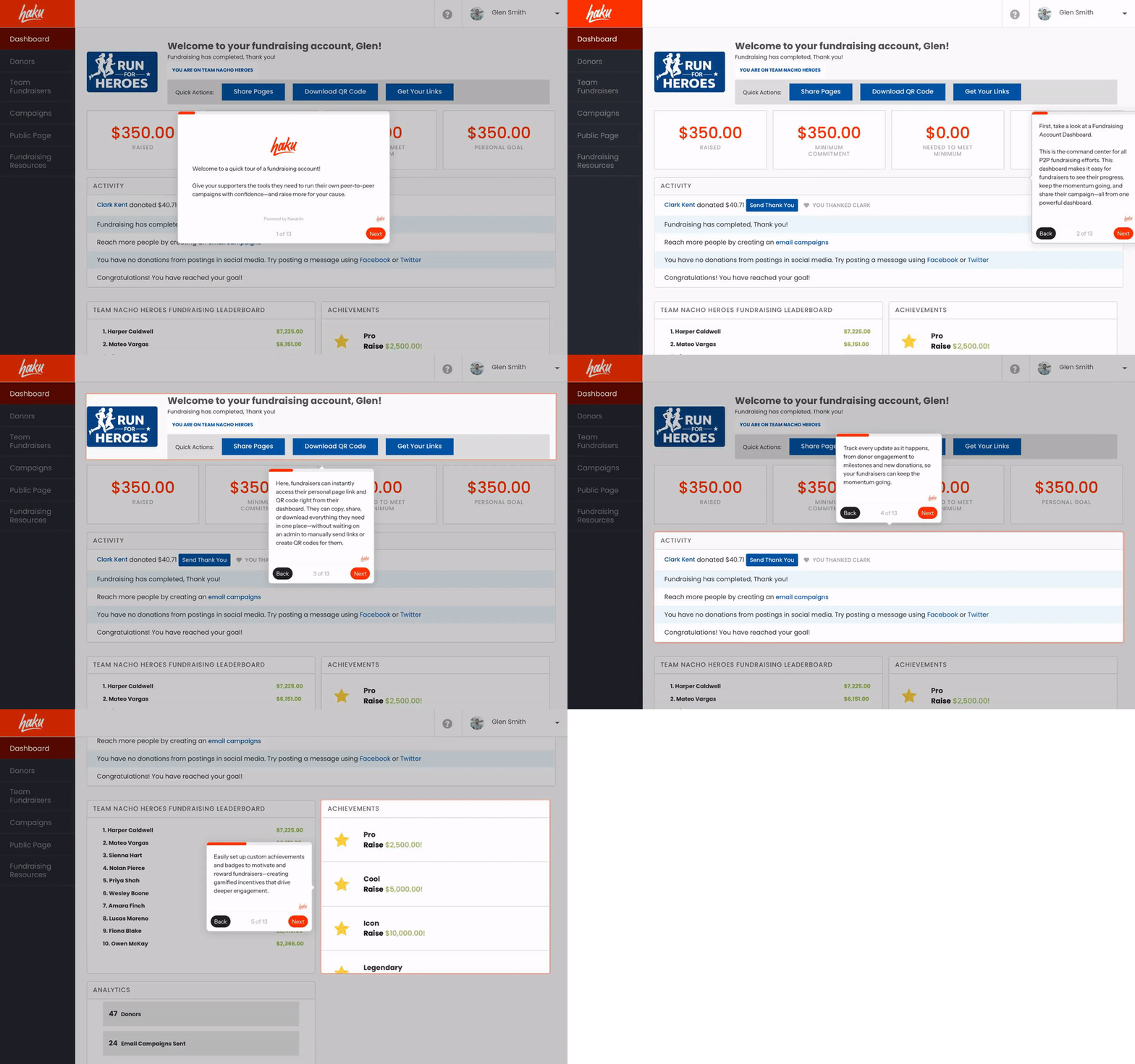
All that said, technology plays a role, yet choosing the right platform alone will accomplish little without a strategy behind it. Clear systems matter, as does consistent leadership. Technology should simplify execution and support the mission rather than compete for attention or consume staff energy.
Stronger P2P outcomes, particularly in endurance and challenge campaigns, emerge from systems that help everyday supporters take steady, confident action and deliver the support their fundraisers need to succeed. Let’s take a look at 5 core ways that you can empower your fundraisers to attract more donors.
1. Arm them with the language they need to succeed
A large number of participants never send a meaningful fundraising message. No matter how committed they are, words can feel hard to find. Much of this hesitation comes about because people worry about hitting the right tone. They worry about sounding transactional so drafts sit half-finished as days, weeks, or months pass.
Without guidance, your loyal supporters must invent a message under pressure.
We recommend you provide a framework that reduces uncertainty. It can be simple, something as easy as:
- Why they are participating
- Why this cause matters to them
- A clear, specific invitation
Here’s an example:
“I am training for my first half marathon to support families facing housing insecurity in our community. If you are able, would you consider a $25 gift to help me reach my $750 goal?”
As simple as a message like this might seem, letting your fundraisers know what they can say will almost certainly help them find their own voice too.
Customizable fundraising pages strengthen this effort, especially when personalization feels intuitive. Provide a set of templates that they can pull from to get a leg up on starting their fundraising pages, sending their first email, or even a script to chat with their friends about this issue that matters to them.
2. Coach Your Fundraisers on Expanding Their Circle of Giving.
Most P2P revenue flows from close relationships. Many fundraisers remain within that inner circle and don’t tap the significant opportunities just outside their immediate friends and family.
Most of your fundraisers have some presence on social media. For example, endurance event participants fundraising for a marathon will likely share long runs, routes, and weekly milestones. Those updates generate engagement, but if they don’t know that they can attach a fundraising ask, they may never think to do so.
We recommend you encourage supporters to think in expanding circles:
Immediate friends and family: Start with direct, personal outreach such as a one to one text or email that includes a specific dollar ask and a clear goal.
Extended acquaintances: Share milestone moments publicly on social media with a clear link and direct invitation, repeating the message more than once to reach different segments of your network.
Professional networks: Provide a short, professional script supporters can use on LinkedIn or internally at work, and remind them to check for employer matching opportunities.
Community and affinity groups: Suggest they leverage existing gatherings, newsletters, or meetings to make a brief, confident ask supported by a simple link or QR code.
Each of these audiences already hold a connection to the supporter, so a direct invitation gives your fundraisers a way to share how they can help.
This part is critical. You must make sharing effortless. Streamlined email tools, simple social integrations, and QR codes for in-person gatherings reduce friction between intention and action. Visible progress indicators strengthen momentum. When a donor sees that someone stands at 82 percent of a goal, their donation can feel more relevant.
3. Take Advantage of Built-In Narrative Arcs
This tip applies to all fundraising, but runs, and walks in particular have a narrative built in. Race day is the destination, but training, increasing miles run, pouring in effort, all of these are part of the story as well.
The fundraising story should match that same cadence.
Each training milestone offers an emotional high point both for your fundraisers and their donors. Those moments create natural opportunities for renewed outreach.
After completing a longest run to date, a fundraiser can pair accomplishment with purpose. It might be something as simple as an sms message saying:
“I completed 12 miles this weekend. Help me reach 60 percent of my fundraising goal.”
Here are a few other places where you can align fundraising benchmarks with training progression:
- First major effort connected to 50 percent of goal
- Peak training week tied to 75 percent
- Race week focused on the final stretch
Real-time progress tracking and milestone alerts reinforce this rhythm. Consider using leaderboards to introduce healthy momentum when applied thoughtfully.
The truth is that while many platforms can handle transactions and registrations, far fewer give you the capabilities you need to guide supporter behavior over time. Consider whether you can effectively prompt action from your fundraisers, provide compelling reward tiers, or give them the outreach tools they need to tie their progress to fundraising efforts.
4. Frame Minimums Not as Barriers but as Achievements
Fundraising minimums carry emotional weight because your fundraisers feel a level of personal responsibility for meeting them. Meanwhile your staff also feel accountability for outcomes, because if your fundraisers don’t meet the minimums, you may have spent money on tickets rather than putting those funds towards your mission.
Reframing the need for minimums shifts the energy from a barrier to a mission impacting goal. Rather than focusing on what an individual must do, be sure to make clear what good the funds you generate can do. This might be as simple as arming your fundraisers with messaging like:
“We are $400 away from unlocking support for 10 families. Would you help close the gap?”
Visible goal tracking can also make progress tangible here. Automated alerts at key thresholds create the opportunity for organic outreach, and when that momentum is visible, it’s easier to motivate additional donations, because donors respond to forward motion.
If you can communicate what meeting the minimum will do for your cause and further articulate what exceeding it will make possible, that gives your fundraisers a powerful tool to attract new donors.
5. Build a Structure That Protects Your Team
Urgency can be a powerful motivator. As fundraising deadlines approach urgency mounts, and often that creates pressure not only on your fundraisers, but on your staff as well. Why? Well, urgency means updates, reconciliation, reminders, final pushes to your fundraisers and their donors, and all of this can be a major drain on staff energy and time.
The solution is, of course, automation. Not completely removing the human element, but ensuring that your campaign design includes:
- Well defined fundraising deadlines
- Scheduled communications that don’t need to be designed in the last minute
- View that highlights public milestones
- Clear frameworks for how to escalate to staff when necessary.
Without strong automations in place, you may end up raising significant funds from your P2P program, but it won’t matter because of how many staff resources you had to spend to accomplish that goal. Data reconciliation, manual leaderboard updates, and repeated follow-ups drain capacity.
But your fundraisers don’t need to know about your capacity. They need you to be set up to support them regardless.
A Major Takeaway: Small Teams Depend on Repeatable Systems
Nonprofit teams all operate within tight constraints, especially when the team managing the P2P fundraiser is fewer than 3 people. You already know, any complexity slows your progress and gets in the way of repeatability.
No matter what else you do, we recommend creating repeatable processes that you can use time and again. Make “Develop once, use forever” your motto.
A few things you will likely need:
- A milestone-based communication calendar
- Templates aligned with the phases of the fundraiser (training for endurance for example)
- Triggered outreach sequences at defined fundraising percentages
- Scripts for your fundraisers
- The ability to recreate the “next year’s” version of an event without starting from scratch
Technology in the nonprofit sector should lighten the load. It should amplify mission and support the humans driving it.
An integrated system such as haku, combining registration, fundraising, engagement, and reporting, reduces tool sprawl and minimizes reconciliation. That means your overall repeatability and efficiency both improve, and your staff attention can focus on relationships and strategic growth.
From Launching Campaigns to Enabling People
High performing P2P programs are not powered by enthusiasm alone. They are designed to reduce friction at every step of the supporter journey. When organizations reduce the friction from:
- Cognitive friction, by providing clear storytelling guidance
- Social friction, by giving them a guide to intentionally expand their network
- Momentum friction by aligning their fundraising with milestones
- Emotional friction by making their progress transparent and exciting
- Operational friction by providing infrastructure that also protects your staff’s capacity
Your supporters will rise to the occasion.
Want to see how haku can help you run more effective P2P fundraisers, check out our fundraising account product tour. Meanwhile, if you're ready to arm your fundraisers with everything they need to smash their fundraising goals and fund your mission, haku is ready to talk.
Frequently Asked Questions About P2P Fundraising Strategy
Can P2P Fundraising Incorporate Corporate Matching?
Yes, and it’s often underused. Employer matching can significantly increase total campaign revenue, but it only works if you actively prompt fundraisers and donors to check eligibility early and often. Include simple reminders in milestone emails, provide a short script fundraisers can use with colleagues, and make matching information easy to find on your donation page. When automated, these reminders add revenue without adding staff workload.
What Role Does AI Play in Reducing Fundraising Friction?
AI is most useful when it helps fundraisers take action faster, so long as it does not replace your authentic voice. It can draft personalized outreach messages, suggest milestone-based prompts, and identify participants who may need a nudge. For small nonprofit teams, the value of AI is in reducing hesitation and saving time, while keeping the human story at the center of the ask. To help with this, haku recently announced a new Operational Intelligence AI feature that you may be interested in learning more about.
What is the Biggest Obstacle to P2P Fundraising Success?
The biggest obstacle to P2P fundraising success is lack of structure. Many organizations focus heavily on recruitment but provide limited guidance after participants register. Without clear milestones, templates, reminders, and visible progress tracking, supporters stall and staff scramble late in the campaign. Strong systems close the gap between intention and action.
How Does haku Help Nonprofits Run Successful P2P Fundraising Programs?
haku brings registration, fundraising, engagement tools, and reporting into one integrated system, reducing tool sprawl and manual reconciliation. This allows organizations to automate milestone-based outreach, provide fundraisers with built-in messaging support, track progress in real time, and replicate successful campaigns year over year all while protecting staff capacity.